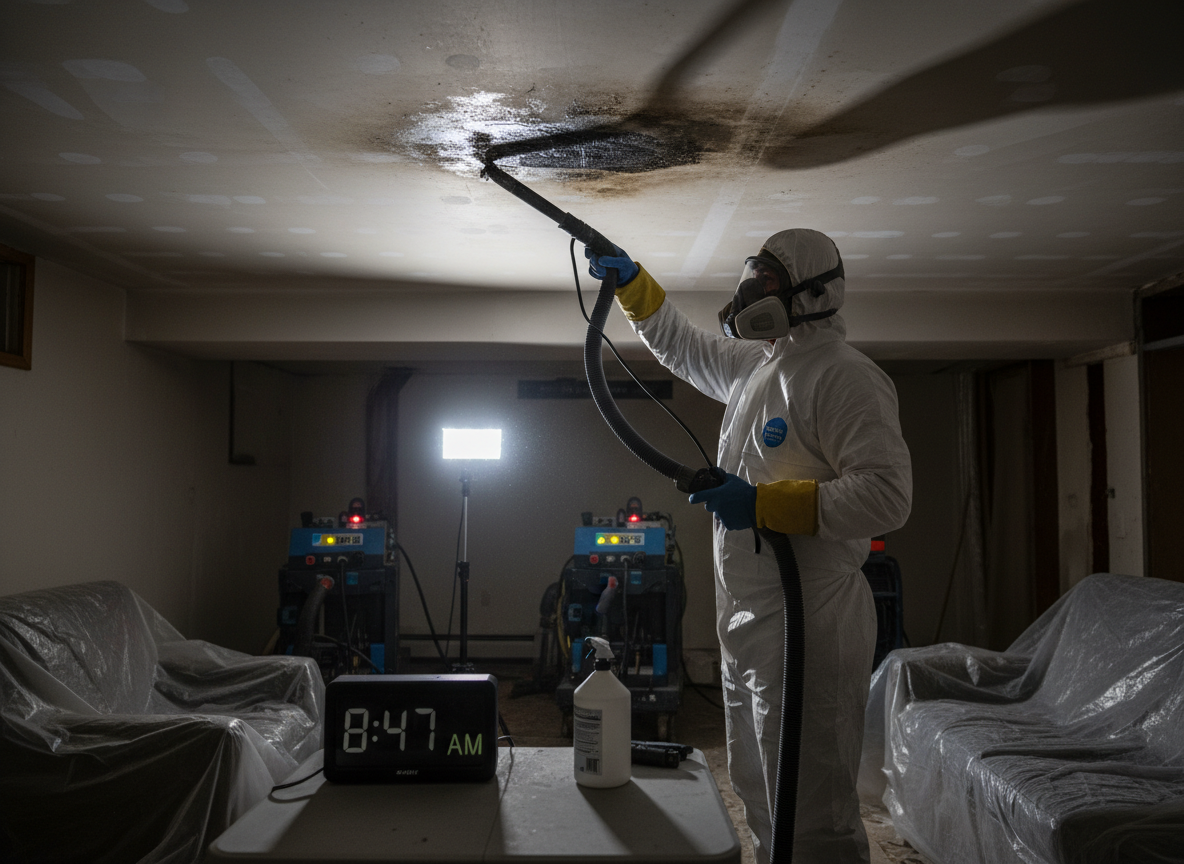
Edwards sits in Kern County’s high desert where hot summers give way to cool winters that often drive indoor humidity spikes inside base housing and older single-family homes. Moisture from evaporative coolers, roof leaks after rare heavy rains, and poor ventilation in crawl spaces creates hidden mold colonies that spread through HVAC ducts common in military family housing along the flight line. A 24 hour mold removal call typically starts with containment using plastic barriers and negative air machines to keep spores from migrating into living areas while crews map moisture with infrared cameras and pin meters.
Work in Edwards demands attention to the age of base-adjacent homes built from the 1950s through the 1980s that often contain older drywall and insulation holding residual water after plumbing failures. Crews remove affected materials down to clean substrate, apply EPA-registered antimicrobials, and run industrial dehumidifiers sized for desert air that can re-absorb moisture quickly once temperatures drop at night. Homeowners near the base frequently overlook mold behind kitchen cabinetry or in laundry rooms where constant dryer exhaust meets cooler exterior walls, allowing growth to remain undetected until odors appear.
After removal, final clearance testing confirms spore counts match outdoor baselines before reconstruction begins. Because Edwards experiences wide daily temperature swings, crews schedule follow-up visits within 48 hours to verify that dehumidification has held and no new colonies have started in previously dry wall cavities. This sequence prevents callbacks that occur when standard remediation skips the overnight monitoring required by the region’s climate.
Technician insight
In Edwards, the thing that catches most people out with 24 hour mold removal is how quickly the high desert’s cool winter nights let moisture re-condense inside wall cavities after the sun drops, especially in the older base housing along the flight line where single-pane windows and uninsulated ducts create hidden cold spots.
Hidden growth behind base laundry room
A resident near Edwards Air Force Base noticed a musty smell after a winter pipe drip. Inspection found black mold extending two feet up the drywall behind the washer and into the adjacent HVAC return. Crews contained the room, removed the affected sections, treated the framing, and ran drying equipment overnight. Clearance testing the next day allowed the family to return without further spread into the rest of the house.
How it works
- 1
Emergency Assessment
Technician arrives within hours, inspects all affected rooms using moisture meters and thermal imaging, and isolates the contaminated zone.
- 2
Containment and Removal
Plastic sheeting and HEPA air scrubbers seal the work area while damaged drywall, insulation, and trim are cut out and bagged for disposal.
- 3
Cleaning and Treatment
Remaining surfaces receive antimicrobial application followed by thorough HEPA vacuuming to capture residual spores.
- 4
Drying and Verification
Industrial dehumidifiers and air movers run until moisture readings reach safe levels, then independent testing confirms clearance.
Pricing
Upfront quotes provided after inspection; costs vary by square footage, depth of hidden growth, and access to wall cavities.